
Cost of living · Madrid
What does it cost to live in Madrid?
Madrid costs less than Paris or Amsterdam. What you pay depends on who is moving — and most of all on which neighbourhood you choose.
Updated February 2026 · our reading of official public data · Domior Discover

Your monthly budget
What you'll spend each month
Three real households. Rent is the biggest number. The rest changes much less than people expect.
One person
a one-bed flat outside the centre
≈ €1,611
Per month
- Rent — one-bed outside the centre
- €1,058
- Food and shopping (estimate)
- €260
- Transport — one monthly pass
- €32.70
- Gas, water and electricity (estimate)
- €130
- Phone, internet and going out (estimate)
- €130
A couple
a one-bed flat in the centre
≈ €2,280
Per month
- Rent — one-bed in the centre
- €1,395
- Food and shopping (estimate)
- €450
- Transport — two monthly passes
- €65.40
- Gas, water and electricity (estimate)
- €160
- Phone, internet and going out (estimate)
- €210
A family of four
two adults, two children, a three-bed outside the centre
≈ €2,806
Per month
- Rent — three-bed outside the centre
- €1,601
- Food and shopping (estimate)
- €650
- Transport — two monthly passes
- €65.40
- Gas, water and electricity (estimate)
- €190
- School things, activities and extras (estimate)
- €300
The big one
Rent decides your budget
Look at the three budgets again. One line does most of the work. Rent is more than half of what one person spends here. It is also the only number that changes by hundreds of euros, not tens. Food, transport, the gym, a dinner out — these cost about the same in a cheap neighbourhood and an expensive one. So you do not really choose a budget for Madrid. You choose a neighbourhood, and the budget follows.
Renting
What different rents get you
These are today's advertised prices — what landlords are asking right now. They are market prices, not the official government number.
€1,058
A one-bed outside the centre
Cheaper, further out, and getting more popular. The metro still reaches the centre in about twenty minutes.
Outside the centre
€1,395
A one-bed in the centre
Central, elegant and full of trees. You pay for the address, and you get a very good one.
In the centre
€1,601
A three-bed outside the centre
Room for a family, quiet streets, and you can walk the children to school.
Outside the centre
€2,447
A three-bed in the centre
Space, light, and the best park in the city at your door. These are the most expensive streets in Madrid.
In the centre

Where to live
Cheaper and more expensive areas
€947 is the government's official rent number. It comes from contracts people already signed, so it is lower than the price of a flat today. A new one-bed flat in the centre is advertised at about €1,395. When you plan your budget, use the higher number.
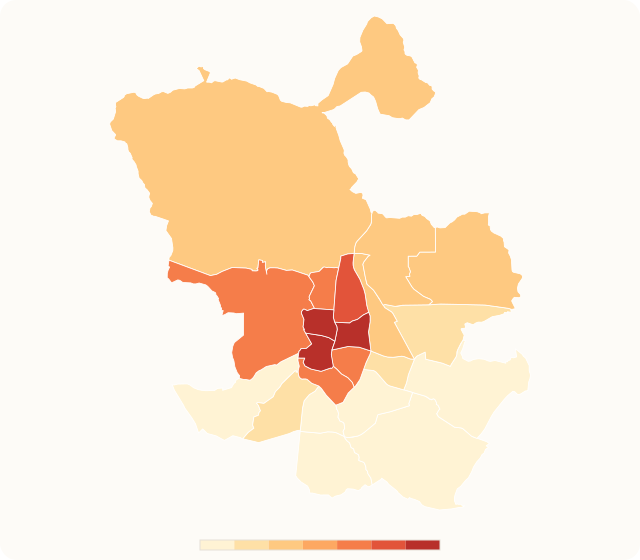 1Villaverde€10.22/m²2Usera€10.71/m²3Villa de Vallecas€10.85/m²4Vicálvaro€10.91/m²56Latina€11.28/m²78Carabanchel€11.49/m²9San Blas - Canillejas€12.14/m²10Barajas€12.68/m²11Ciudad Lineal€12.87/m²12Hortaleza€13.05/m²13Fuencarral - el Pardo€13.32/m²14Moncloa - Aravaca€15.19/m²15161718192021
- 1Villaverde€10.22/m²
- 2Usera€10.71/m²
- 3Villa de Vallecas€10.85/m²
- 4Vicálvaro€10.91/m²
- 5Puente de Vallecas€10.97/m²
- 6Latina€11.28/m²
- 7Moratalaz€11.44/m²
- 8Carabanchel€11.49/m²
- 9San Blas - Canillejas€12.14/m²
- 10Barajas€12.68/m²
- 11Ciudad Lineal€12.87/m²
- 12Hortaleza€13.05/m²
- 13Fuencarral - el Pardo€13.32/m²
- 14Moncloa - Aravaca€15.19/m²
- 15Tetuán€15.68/m²
- 16Retiro€15.69/m²
- 17Arganzuela€15.76/m²
- 18Chamartín€16.73/m²
- 19Centro€17.71/m²
- 20Salamanca€17.87/m²
- 21Chamberí€18.37/m²
The cheaper areas
≈ €11.35 / m²
Villaverde · Usera · Villa de Vallecas · Puente de Vallecas · Latina · Vicálvaro · Moratalaz
Your money goes a long way here. The streets are rougher in places, but these are real neighbourhoods, and the metro puts you in the centre in twenty minutes.
The middle
≈ €13.62 / m²
Carabanchel · San Blas-Canillejas · Barajas · Ciudad Lineal · Hortaleza · Fuencarral-El Pardo · Moncloa-Aravaca
This is where we send most newcomers. Close enough to the centre, calmer, and easy to live in. You also skip the extra you pay two districts over.
The expensive areas
≈ €16.27 / m²
Chamberí · Salamanca · Centro · Chamartín · Arganzuela · Retiro · Tetuán
Beautiful, easy to walk, and priced that way. Worth it if being central is the whole point. If it is not, you are paying for the name.

Personal help
Which parts of Madrid fit your budget?
Dom finds the areas that match your money and the way you want to live.
Request early accessDom is your AI companion for moving to Spain. Launching soon.
These are the official rents — what people already living here pay, on the books. New flats are advertised 40–70% higher. Today a one-bed in the centre is advertised at €1,395.
Day to day
What things cost day to day
This is the part you feel every week — coffee, a beer, the weekly shop. For a European capital, Madrid is cheap.
€2.72
Cappuccino
€3.50
A beer out (½ litre)
€16
Menú del día
€10
A fast-food meal
€60
Dinner for two
€46.85
A week's groceries
€1.30
Bread
€1.12
Milk
€3.36
Eggs
€0.91
Bottled water
€1.50
A single bus or metro ticket
€32.70
Monthly transport pass (Abono zone A, discounted rate)
€16
Mobile plan, per month
€30.78
Home internet, per month
€42.66
Gym, per month
€10
Cinema ticket

Good to know
What surprises people
The surprise is not the price of a coffee. It is how often you go out for one. Eating and drinking here is cheap enough to become a habit. A €3 beer is nothing until you have had forty of them in a month. The other surprise works the other way. Things that cost a lot in London or Amsterdam are small here. Most people overestimate daily life and underestimate the flat.
Getting around
Do you need a car? No.
Madrid is easy to walk and the metro is fast. Unless you live past the ring road, you can skip the car, the parking and the petrol.
€32.70
A monthly transport pass (the Abono) covers every metro, bus and local train in zone A.
6,304
Public transport stops across the city. Most homes are a short walk from one.

Moving in
What you pay before you move in
The monthly budget is the easy part. The move itself is what catches people short, so here is what to have ready.
First month's rent, up front
€1,395
Based on a one-bed in the centre at today's advertised rate.
Deposit (fianza) — one month
€1,395
Official. Ley de Arrendamientos Urbanos — one month's rent, held and returned.
Additional guarantee — up to two months
up to €2,790
Official. Ley de Arrendamientos Urbanos — landlords may ask for up to two further months.
The agency fee
€0
Official. Ley 12/2023, art. 20 — since the 2023 housing law the agency fee is the landlord's to pay, not yours.
Worst case, before you have keys
€5,580
First month plus deposit plus the full two-month guarantee, at €1,395 a month.
Or somewhere else?
Madrid, Barcelona or Valencia?
If you are choosing between Spain's big three, the rent tells most of the story.
Madrid
- A one-bed in the centre
- €1,395
- A three-bed in the centre
- €2,447
The most jobs, the best transport, and the highest rents of the three.
Barcelona
- A one-bed in the centre
- €1,452
- A three-bed in the centre
- €2,314
The sea and the design, and rents as high as Madrid's with a tighter market.
Valencia
- A one-bed in the centre
- €1,256
- A three-bed in the centre
- €1,974
Cheaper than both, on the coast, and smaller. Fewer jobs in English.
Asked a lot
Good questions
Is Madrid expensive?
- For a big European capital, no. One person can live on about €1,600 a month, rent included. The neighbourhood you choose changes the total more than anything else.
How much is rent in Madrid?
- A one-bed flat is advertised at about €1,058 outside the centre and €1,395 in the centre. The government's official figure is lower because it comes from older signed contracts — plan with the higher, asking price.
Do you need a car in Madrid?
- No. The metro is fast and a monthly pass costs €32.70. Unless you live past the ring road, you can skip the car, the parking and the petrol.
What do you pay before you move in?
- The first month's rent, a one-month deposit, and sometimes up to two more months as a guarantee. The agency fee is €0 — since a 2023 law the landlord pays it, not you.
In short
The neighbourhood decides the cost
These numbers are a starting point. What you spend depends on how you live.
The biggest difference in your monthly cost is the neighbourhood you pick. Choose the right area and Madrid is affordable.
Official rents come from Spain's Ministry of Housing (Ministerio de Vivienda y Agenda Urbana, SERPAVI) — https://www.mivau.gob.es/vivienda/alquila-bien-es-tu-derecho/serpavi. Asking rents and everyday prices are market estimates. Rents come from official government records and from current listings. Everyday prices and the household budgets are estimates, meant as a guide.
Personal help
Which parts of Madrid fit your budget?
Dom finds the areas that match your money and the way you want to live.
Request early accessDom is your AI companion for moving to Spain. Launching soon.
Sources & provenance
- Zyla — Spain Cost of Living APITier 3 · ES · Retrieved Jul 30, 2026
- Domior Geographic IntelligenceTier 3 · ES · Retrieved Feb 15, 2026 – Jul 30, 2026
- CRTM — fare tablesTier 1 · ES · Retrieved Jan 1, 2026 – Jul 30, 2026
- BOE — Ley de Arrendamientos Urbanos / Ley 12/2023Tier 1 · ES · Retrieved Jul 30, 2026