
Family life in Madrid
Is Madrid a good place to raise a family?
Yes, and it may be the easiest big city in Spain to build a family life in. Madrid has the most work, the best transport, and more parks, museums and free things to do with children than anywhere else in the country. Children ride the Metro to school, spend Sundays in the Retiro park, and grow up around the world, because nearly one in four people here comes from another country. The catch is cost, and in high summer, heat. Madrid has Spain's highest rents. A three-bedroom flat is about €1,600 a month outside the centre and around €2,447 in it, and the good ones go fast. July and August are hot and dry, and there is no sea to cool off in. Plan for the rent, start your flat and school search early, and few cities give a child more to do.
Updated August 2026 · our reading of official public data · Domior Discover

At a glance
Madrid for families, in six numbers
23%
International community
nearly one in four residents
3.3M
City size
average age 44
14%
Under 16
about one child in seven
€1,601
Three-bed flat
to rent outside the centre; €2,447 in the centre
6,304
Transit stops
the densest network in Spain
Barajas
Airport
in the city's north-east
A family's budget
What a family spends each month
Rent is the big one. The rest changes far less than people expect.
A family
two adults and children
≈ €3,191
Per month
- Rent, three-bed outside the centre
- €1,601
- Food and groceries for a family
- €700
- Transport, two adult passes (children under 14 free)
- €110
- Power, water, internet and mobile
- €220
- Kids, going out and the rest
- €560
Or somewhere else?
Madrid, Barcelona or Valencia?
Madrid and Barcelona cost about the same. Valencia is clearly cheaper. Here is the same three-bedroom flat in the centre of each.
Madrid
- A three-bed in the centre
- €2,447
The most jobs and the best transport, inland.
Barcelona
- A three-bed in the centre
- €2,314
About the same money, with the sea.
Valencia
- A three-bed in the centre
- €1,974
Coast and city for clearly less.
What family life costs
The costs that come with children
Beyond the monthly budget, these are the line items a family carries. School fees vary a lot, so those are marked as estimates.
free
Public nursery, ages 0 to 3
only meals and extra hours are charged
€9,500
International school, per year (estimate)
a typical fee, not the cheapest; the range is about €4,100 to €27,000
€54.60
One adult monthly pass (children under 14 free)
for zone A; young people under 26 pay €10
€165
Family utilities: power, water, heating
per month
€60
Dinner out for two
mid-range restaurant, three courses
€9
A cinema ticket
per ticket
€1,601
A three-bed flat, per month
outside the centre; about €2,447 in it
Where families live
Madrid has children all over it
The share of children under 16 in each of Madrid's 21 districts.
There are children in every part of Madrid, but the map hides one thing. Some of the youngest, fastest-growing areas are the new neighbourhoods on the edge, like Sanchinarro, Las Tablas and Valdebebas in the north, or Vallecas in the south-east. They have wide pavements, new schools and playgrounds, and more space for your money. The classic inner districts, like Chamberí, Salamanca and Retiro, are grander and greener but cost more and have fewer children. Many international families settle in the north-west, in and around Chamartín, or head just outside the city to the leafy towns. The best tip is simple: choose your school first. The right area is usually the one near your school.
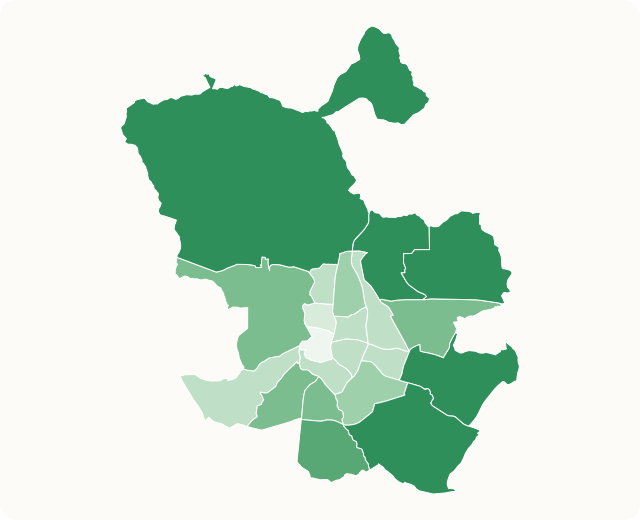 123456789101112131415161718192021
- 1Villa de Vallecas19.0%
- 2Fuencarral - El Pardo17.8%
- 3Barajas17.7%
- 4Hortaleza17.6%
- 5Vicálvaro17.4%
- 6Villaverde16.1%
- 7Usera15.0%
- 8San Blas - Canillejas14.6%
- 9Carabanchel14.3%
- 10Moncloa - Aravaca14.2%
- 11Chamartín13.7%
- 12Puente de Vallecas13.6%
- 13Ciudad Lineal12.3%
- 14Retiro12.2%
- 15Latina12.1%
- 16Arganzuela12.1%
- 17Tetuán11.5%
- 18Moratalaz11.4%
- 19Salamanca11.2%
- 20Chamberí10.7%
- 21Centro7.6%
Share of children under 16 in each of Madrid's 21 districts.

Personal help
Which part of Madrid fits our family, schools and budget?
Dom finds the areas that match your money and the way you want to live.
Request early accessDom is your AI companion for moving to Spain. Launching soon.

Schools
How school works, and what it costs
Schooling is usually the decision that shapes everything else, so start it early. Public schools in Madrid teach in Spanish, and children pick the language up fast. Many state schools also run a well-known bilingual programme, begun in 2004, where a good part of the timetable, and at least two subjects, are taught in English. That makes Madrid an easy place for a child to become bilingual inside the free public system.
There are three kinds of school. Public schools are free. Concertado schools are state-funded and free in principle, but most ask families for a monthly contribution. Across Spain that voluntary fee averages roughly €680 to €860 a year, about €60 to €70 a month. Treat it as a guide, not a fixed price, because it changes a lot from school to school. Private and international schools charge full fees.
Madrid has about 73 international schools, the largest choice in Spain, with British, American, French, German and International Baccalaureate options. Treat the search as a project you begin before you move. Shortlist several, apply in parallel, and check each school's curriculum, language of instruction and waiting list, because the best-known names fill up early.
On fees, plan with a range rather than a single figure, and treat every number here as an estimate, not an official price. International school tuition in Madrid runs roughly €4,100 to €27,000 a year, depending on the school. A typical place sits around €9,500, which is why the figure we show is a mid-range estimate and not the cheapest. On top of tuition, expect a one-off registration fee, usually non-refundable, plus recurring costs for lunch, school transport and uniforms that each school sets on its own. Always confirm the exact figures with each school before you commit.
Childcare
For the small ones
For under-threes, Madrid is unusually generous. Since the 2019/20 school year the region has made the public nurseries, the escuelas infantiles and casas de niños, free for the schooling itself. Families pay only for meals and for any extra hours beyond the standard day. Places are limited and allocated each spring, so apply in the window. A private nursery is the faster route if you miss a public place, and prices vary widely by area.
Getting around
You do not need a car
Free under 14
Children under 14 travel free. Young people under 26 pay €10 a month for the whole region. A standard adult monthly pass for the central zone is €54.60.
Madrid has about 6,304 transit stops, the densest network in Spain, across the Metro, city buses, light rail and the Cercanías commuter trains. Adolfo Suárez Madrid-Barajas airport sits in the city's north-east, on the Metro. Most families cross the city every day without ever needing a car.
Weather through the year
Dry, sunny, with a real winter and a hot summer
About 15°C across the year. Cold, bright winters and hot, dry summers, with little rain.
Official figureAEMET normals, Madrid Retiro.
Leisure
A city built for children
Madrid does not have a beach, but it makes up for it with space to run and things to do. The Retiro is the family park, with a boating lake, puppet shows and open lawns. Casa de Campo, far bigger, has the zoo and a cable car, and Madrid Río has turned the riverbank into miles of playgrounds and cycle paths. On a hot day there are public pools all over the city. Add the free children's workshops at the big museums, and a wet Sunday is never a problem.
The one thing to plan for
Spain's highest rents
Madrid is the most expensive place to rent in Spain. A three-bedroom flat is about €1,601 a month outside the centre and around €2,447 in it, and good listings move fast. Line up your paperwork, run your school and flat searches at the same time, and be ready to decide quickly. If the city-centre price is too much, the leafy towns just outside are where many families land.
If not here
Where families go for more space
Pozuelo de Alarcón
Madrid's wealthiest suburb, just west of the city and on the C-10 Cercanías line. Houses with gardens, top schools, and a short hop into the centre.
Majadahonda
A leafy, family-first town on the same C-10 line, with good schools, sports clubs and plenty of green space.
Las Rozas
A little further out on the C-10, popular with families for its newer housing, parks and big retail and leisure areas.

Personal help
Which part of Madrid fits our family, schools and budget?
Dom finds the areas that match your money and the way you want to live.
Request early accessDom is your AI companion for moving to Spain. Launching soon.
Sources & provenance
- INE — Padrón, población por nacionalidad y país de nacimientoTier 4 · ES-MD · Retrieved Aug 8, 2026
- Domior Geographic IntelligenceTier 3 · ES-MD · Retrieved Aug 8, 2026
- Numbeo — Cost of Living, MadridTier 4 · ES-MD · Retrieved Aug 8, 2026
- Comunidad de Madrid — free public nursery since 2019/20 (Decreto 28/2019)Tier 4 · ES-MD · Retrieved Aug 8, 2026
- International Schools Database — MadridTier 4 · ES-MD · Retrieved Aug 8, 2026
- International Schools Database — Madrid feesTier 4 · ES-MD · Retrieved Aug 8, 2026
- CRTM — Madrid transport fares (children under 14 free; Abono Joven)Tier 4 · ES-MD · Retrieved Aug 8, 2026
- Idealista — Madrid rental price reportTier 4 · ES-MD · Retrieved Aug 8, 2026
- Comunidad de Madrid — Programa Bilingüe (since 2004)Tier 4 · ES-MD · Retrieved Aug 8, 2026
- EsadeEcPol — Fees at concertado schools in SpainTier 4 · ES · Retrieved Aug 8, 2026
- AEMET — Valores climatológicos normales, Madrid Retiro (3195)Tier 4 · ES-MD · Retrieved Aug 8, 2026