
Family life in Barcelona
Is Barcelona a good place to raise a family?
Yes, with one honest catch worth planning for. Barcelona gives children a life outdoors. They walk to school, the metro and trams reach almost everywhere, and the city beaches sit at the end of a short ride. Weekends happen in the squares, the parks and on the sand, not in the back of a car. The catch is cost. Barcelona is expensive, and a three-bedroom flat is hard to find. The official registered rent for one, about 80 m², is around €1,094 a month citywide. But to actually rent one today you pay far more: about €1,679 outside the centre, or €2,314 in it. Plan for the higher number, and start your flat and school search early. Do that, and few cities give a child a childhood by the sea like this one.
Updated August 2026 · our reading of official public data · Domior Discover

At a glance
Barcelona for families, in six numbers
28%
International community
more than one in four residents
1.6M
City size
average age 45
13%
Under 16
about one child in eight
€1,679
Three-bed flat
to rent outside the centre; €2,314 in the centre
3,165
Transit stops
almost everywhere
El Prat
Airport
just south of the city
A family's budget
What a family spends each month
Rent is the big one. The rest changes far less than people expect.
A family
two adults and children
≈ €3,175
Per month
- Rent, three-bed outside the centre
- €1,679
- Food and groceries for a family
- €680
- Transport, two adult passes (children under 16 free)
- €46
- Power, water, internet and mobile
- €210
- Kids, going out and the rest
- €560
Or somewhere else?
Barcelona, Madrid or Valencia?
Barcelona costs about what Madrid costs, and clearly more than Valencia. Here is the same three-bedroom flat in the centre of each.
Barcelona
- A three-bed in the centre
- €2,314
Big-city life by the sea, at big-city rent.
Madrid
- A three-bed in the centre
- €2,447
About the same money, inland, with the most jobs.
Valencia
- A three-bed in the centre
- €1,974
Coast and city for clearly less.
What family life costs
The costs that come with children
Beyond the monthly budget, these are the line items a family carries. Nursery and school fees vary a lot, so those are marked as estimates.
free
Public nursery, age 2 to 3
you pay only for meals
€764
Private nursery, per month
typical fee; varies by nursery
€14,180
International school, per year (estimate)
a typical primary fee, not the cheapest; the range is about €8,000 to €22,000
€46
Two adult passes (children 4 to 16 free)
per month
€159
Family utilities: power, water, heating
per month
€60
Dinner out for two
mid-range restaurant, three courses
€10
A cinema ticket
per ticket
€1,679
A three-bed flat, per month
outside the centre; about €2,314 in it
Where families live
Barcelona has children all over it
The share of children under 16 in each of Barcelona's 10 districts.
There are children in every part of Barcelona. But the map hides one thing. Many children live in the rich areas up the hill. Many also live in the poorest areas on the edge. So a big number on its own does not mean an area is right for you. Look at the map and at what the area is really like. Most international families pick the green streets up the hill: Sarrià, Sant Gervasi, Les Tres Torres and Pedralbes. There the streets are calm and the flats are bigger. Many international schools are there too. Gràcia feels like a village, with squares full of kids. Down by the sea, families give up a little space for the beach. The best tip is simple: choose your school first. When flats are this hard to find, the best area is usually the one near your school.
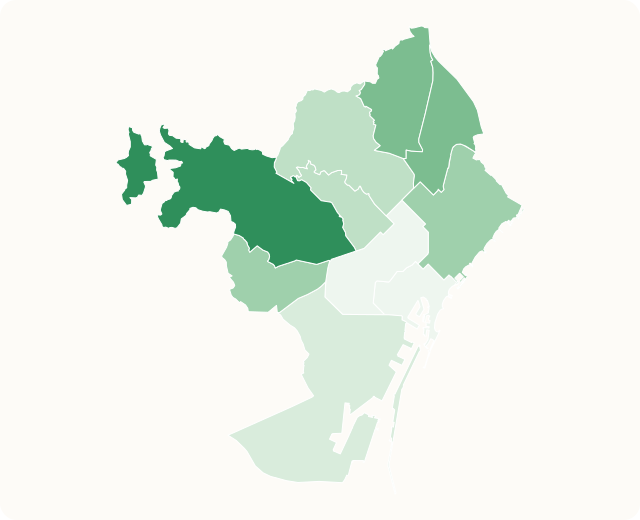 Sarrià-Sant Gervasi16.1%Nou Barris14.0%Sant Andreu14.0%Sant Martí13.7%Les Corts13.2%Horta-Guinardó12.9%Gràcia12.5%Sants-Montjuïc12.1%Eixample11.1%Ciutat Vella10.8%
Share of children under 16 in each of Barcelona's 10 districts.

Personal help
Which part of Barcelona fits our family, schools and budget?
Dom finds the areas that match your money and the way you want to live.
Request early accessDom is your AI companion for moving to Spain. Launching soon.

Schools
How school works, and what it costs
Schooling is usually the decision that shapes everything else, so start it early. Public and semi-private (concertado) schools teach mainly in Catalan, which has long been the main working language of the classroom. Spanish and English are taught too, and a 2021 court ruling now requires at least a quarter of lessons in Spanish, though that remains contested. Children pick Catalan up quickly, but it is the first thing to understand about state schooling here.
Public schools are free. Concertado schools are state-funded too and free in principle, but most in Catalonia ask families for a monthly contribution. It is meant to be voluntary, yet it is the highest in Spain: on average around €140 a month, or roughly €1,700 a year. Treat that as a guide, not a fixed price, because it changes a lot from school to school.
Barcelona also has about 56 international schools, a broad and deep private sector with British, American, French, German and International Baccalaureate options. Treat the search as a project you begin before you move. Shortlist several, apply in parallel, and check each school's curriculum, language of instruction and waiting list, because the best-known names fill up.
On fees, plan with a range rather than a single figure, and treat every number here as an estimate, not an official price. International school tuition in Barcelona runs roughly €8,000 to €22,000 a year, depending on the school. A typical primary place sits in the middle, around €14,000, which is why the figure we show is a mid-range estimate and not the cheapest. On top of tuition, expect a one-off registration fee of about €500 to €2,000, usually non-refundable, plus recurring costs for lunch, school transport and uniforms that each school sets on its own. Always confirm the exact figures with each school before you commit.
Childcare
For the small ones
For under-threes, the city runs public nurseries called escoles bressol, and the way they cost is worth knowing. The oldest group, age 2 to 3, is free for the schooling and care itself, with only meals charged. Younger groups use a sliding scale set by your family income and household size, so what you pay depends on what you earn. Places are limited and allocated each spring, so apply in the window. A private nursery is the faster route if you miss a public place, at roughly €764 a month.
Getting around
You do not need a car
€22.80
A monthly adult pass (the T-usual). Children aged 4 to 16 travel free on the T-16 card.
Barcelona has about 3,165 transit stops, roughly 31 for every square kilometre, across metro, bus, tram, the FGC trains and Rodalies. El Prat airport sits just south of the city. Most families cross the city daily without ever thinking about a car.
Weather through the year
Mild, sunny, and warm in the middle
About 16°C across the year. Gentle winters, warm summers, most of the rain in autumn.
Official figureAEMET normals, Barcelona Fabra.
Leisure
And then there are the beaches
This is where Barcelona earns its reputation for family life. A string of city beaches sits right on the metro and tram, from Barceloneta through Nova Icària, Bogatell and Mar Bella, so a swim after school is a normal Tuesday, not a holiday. Inland, the Parc de la Ciutadella is the family park, with lawns, a boating lake and the zoo. Montjuïc has gardens, pools and museums on the hill, and the Collserola ridge behind the city gives you real countryside and the Carretera de les Aigües for a walk with a view. For a treat there is Tibidabo, the old hilltop funfair, and the aquarium down at the port.
The one thing to plan for
Expensive, and hard to find
The official registered rent for a three-bedroom flat, about 80 m², is around €1,094 a month citywide. But to actually rent one today you pay far more: about €1,679 outside the centre, or €2,314 in it, and good listings move fast. That gap is the squeeze in one line. Line up your paperwork, run your school and flat searches at once, and be ready to decide quickly.
If not here
Where families go for more space
Sant Cugat del Vallès
Over the Collserola hill to the north-west, about 20 minutes by FGC train. Leafy and prosperous, full of houses with gardens and top schools, while staying firmly connected to the city.
Cerdanyola del Vallès
Greener and more open, a university town in the Vallès with more room for your money and a direct train line into the city.
Sant Just Desvern
Just south-west and almost touching the city, quiet and residential with an easy daily hop in.

Personal help
Which part of Barcelona fits our family, schools and budget?
Dom finds the areas that match your money and the way you want to live.
Request early accessDom is your AI companion for moving to Spain. Launching soon.
Sources & provenance
- INE — Padrón, población por nacionalidad y país de nacimientoTier 4 · ES-CT · Retrieved Aug 8, 2026
- Domior Geographic IntelligenceTier 3 · ES-CT · Retrieved Aug 8, 2026
- Zyla — Spain Cost of Living APITier 4 · ES · Retrieved Aug 8, 2026
- Generalitat de Catalunya, Departament d'Educació — Gratuïtat I2Tier 4 · ES-CT · Retrieved Aug 8, 2026
- iSchoolAdvisor — International School Fees Barcelona 2026Tier 4 · ES-CT · Retrieved Aug 8, 2026
- The Local Spain — Catalan schools, 25% Spanish rulingTier 4 · ES-CT · Retrieved Aug 8, 2026
- EsadeEcPol — Fees at concertado schools in SpainTier 4 · ES · Retrieved Aug 8, 2026
- International Schools Database — BarcelonaTier 4 · ES-CT · Retrieved Aug 8, 2026
- TMB — Barcelona metro and bus faresTier 4 · ES-CT · Retrieved Aug 8, 2026
- TMB — T-16 free travel for children 4 to 16Tier 4 · ES-CT · Retrieved Aug 8, 2026
- AEMET — Valores climatológicos normales, Barcelona FabraTier 4 · ES-CT · Retrieved Aug 8, 2026
- Ajuntament de Barcelona — City beachesTier 4 · ES-CT · Retrieved Aug 8, 2026