
Cost of living · Malaga
What does it cost to live in Málaga?
Málaga costs less than Madrid or Barcelona. Rent is where most of your money goes. A one-bedroom flat has two rent numbers. The official registered rent is about €727 a month. It comes from leases people already signed, so it is lower than today's prices. A one-bedroom advertised now asks about €1,270. Plan with the higher one. Here is what Málaga really costs.
Updated February 2026 · our reading of official public data · Domior Discover

Your monthly budget
What you'll spend each month
These costs come every month. Rent is the big one. The rest changes far less than people think.
A single professional
renting alone, working locally
≈ €1,596
Per month
- Rent — one-bed outside the centre
- €862
- Food and groceries
- €280
- Transport — monthly pass
- €24
- Power, water, internet and mobile
- €130
- Going out and everything else
- €300
A couple
two incomes, wanting to be central
≈ €2,198
Per month
- Rent — one-bed in the centre
- €1,270
- Food and groceries for two
- €450
- Transport — two passes
- €48
- Power, water, internet and mobile
- €160
- Going out and everything else
- €270
A family
two adults and children, space over postcode
≈ €2,900
Per month
- Rent — three-bed outside the centre
- €1,436
- Food and groceries for a family
- €650
- Transport
- €70
- Power, water, internet and mobile
- €200
- Kids, going out and the rest
- €544
The big one
Rent decides your budget
Málaga has two rent numbers, and they are far apart.
Rent is your biggest cost. It changes the most, too. The government records an official rent of €727 a month. Flats today ask for about €1,270. That is 1.75 times higher. Many flats here became short-stay tourist lets. That leaves fewer flats to rent long-term, so asking prices rose. The city has now stopped new tourist-flat licences for three years. Food, transport and going out cost about the same across the city. So the real question is not your budget. It is which area you choose.
Renting
What different rents get you
These are what flats ask for today. Each is one flat type, at today's advertised price.
€862
A one-bed outside the centre
Working areas outside the centre. More space for your money. Locals priced out of Centro are moving here.
Outside the centre
€1,270
A one-bed in the centre
In the old town. You can walk everywhere. These flats also go to holiday lets.
In the centre
€1,436
A three-bed outside the centre
Near the university. Newer buildings. Real space for a family, without the centre price.
Outside the centre
€2,085
A three-bed in the centre
Family space in the old town. This is the most you would expect to pay.
In the centre

Where to live
Cheaper and more expensive areas
This is the official government rent, by area, per square metre. The map below shows the same thing.
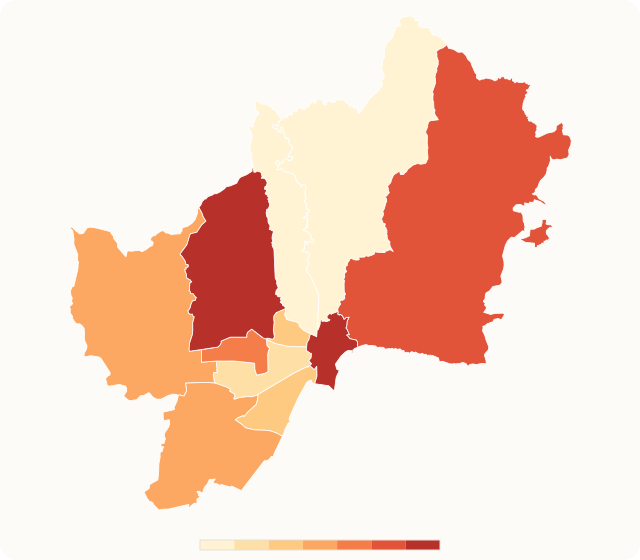 1Ciudad Jardín€7.83/m²2Palma-Palmilla€7.92/m²3Cruz de Humilladero€8.30/m²4Carretera de Cádiz€8.75/m²56Campanillas€9.18/m²7Churriana€9.35/m²89Este€9.98/m²10Puerto de la Torre€10.33/m²11Centro€10.71/m²
- 1Ciudad Jardín€7.83/m²
- 2Palma-Palmilla€7.92/m²
- 3Cruz de Humilladero€8.30/m²
- 4Carretera de Cádiz€8.75/m²
- 5Bailén-Miraflores€8.98/m²
- 6Campanillas€9.18/m²
- 7Churriana€9.35/m²
- 8Teatinos-Universidad€9.68/m²
- 9Este€9.98/m²
- 10Puerto de la Torre€10.33/m²
- 11Centro€10.71/m²
The affordable end
≈ €7.40 / m²
Ciudad Jardín, Palma-Palmilla, Cruz de Humilladero and Carretera de Cádiz. Good value, a little further out.
The typical middle
≈ €9.38 / m²
Bailén-Miraflores, Campanillas, Churriana and Teatinos. Teatinos is popular with students and families.
The top end
≈ €11.85 / m²
Este by the sea. That means El Palo, Pedregalejo and El Limonar. Also Puerto de la Torre, and Centro, the old town. You pay for the beach or the centre. Centro is the most expensive area.

Personal help
Which parts of Málaga fit my budget and the life I want?
Dom finds the areas that match your money and the way you want to live.
Request early accessDom is your AI companion for moving to Spain. Launching soon.
Day to day
What things cost day to day
Here is what everyday things cost in Málaga. These are market estimates, meant as a guide.
€2.40
Cappuccino
€3
A beer out (½ litre)
€15
Menú del día
€9.50
A fast-food meal
€57.50
Dinner for two
€40.77
A week's groceries
€1.31
Bread
€1.13
Milk
€3.05
Eggs
€0.57
Bottled water
€1.40
A single bus or metro ticket
€23.95
Monthly transport pass
€9.79
Mobile plan, per month
€22.65
Home internet, per month
€40.62
Gym, per month
€8.60
Cinema ticket

Good to know
What surprises people
Everyday life here is cheap. Finding a flat takes longer than people expect.
Fewer flats come up for long-term rent in Málaga than you expect. Many went to short-stay tourist lets. The city has now stopped new tourist-flat licences for three years. So plan to look for longer, and be ready to decide fast.
Getting around
Do you need a car? No.
€23.95
A monthly city bus card. The metro is a separate operator, paid per trip.
1,345
Public transport stops across the city. Most homes are a short walk from one.

Moving in
What you pay before you move in
The monthly budget is the easy part. Moving in costs more at once.
First month's rent, up front
€1,270
Based on a one-bed in the centre at today's advertised rate.
Deposit (fianza) — one month
€1,270
Official. Ley de Arrendamientos Urbanos. One month's rent, held and returned.
Additional guarantee — up to two months
up to €2,540
Official. Ley de Arrendamientos Urbanos. A landlord may ask for up to two more months.
The agency fee
€0
Since the 2023 housing law the landlord pays the agency fee. You pay nothing.
Worst case, before you have keys
€5,080
First month plus deposit plus the full two-month guarantee, at €1,270 a month.
Or somewhere else?
Málaga, Madrid or Valencia?
Málaga
- A one-bed in the centre
- €1,270
- A three-bed in the centre
- €2,085
Gentle daily costs; rent is the one pinch point.
Madrid
- A one-bed in the centre
- €1,395
- A three-bed in the centre
- €2,447
Spain's priciest — more to earn, but more to pay.
Valencia
- A one-bed in the centre
- €1,256
- A three-bed in the centre
- €1,974
Málaga's closest match: coast, size and prices all comparable.
Seville
- A one-bed in the centre
- €809
- A three-bed in the centre
- €1,338
Inland and hotter in summer, a touch cheaper on rent.
Asked a lot
Good questions
Is Málaga expensive?
- For Andalusia, yes. A one-bed flat in the centre is advertised at about €1,270 a month. In Seville it is about €809. In Granada it is about €758. The official figure for Málaga is much lower, about €727. That number comes from contracts people already signed.
How much is rent in Málaga?
- You need two numbers. The official government figure is about €727 a month. That is what people already renting pay. It sits well below anything advertised. Today's asking price is about €1,270 for a one-bed in the centre. A little further out it is about €862.
Do you need a car in Málaga?
- Inside the city, no. A monthly city bus card costs €23.95. There are also two metro lines. But no single pass covers the buses and the metro together. The metro and the coast buses are pay-as-you-go on a top-up card. So what you spend depends on how far you go. If you live outside the MA-20 ring road, plan on a car.
What do you pay before you move in?
- Take a flat advertised at €1,270. You pay the first month. You pay one month as a deposit. You may pay up to two more months as a guarantee. That is up to €5,080 before you have keys. The agency fee is €0. Since 2023 the landlord pays it.
In short
The neighbourhood decides the cost
The biggest number in your budget is the area you pick. Choose well and Málaga stays affordable.
Personal help
Which parts of Málaga fit my budget and the life I want?
Dom finds the areas that match your money and the way you want to live.
Request early accessDom is your AI companion for moving to Spain. Launching soon.
Sources & provenance
- Zyla — Spain Cost of Living APITier 3 · ES · Retrieved Jul 30, 2026
- Domior Geographic IntelligenceTier 3 · ES-AN · Retrieved Sep 1, 2025 – Jul 30, 2026
- BOE — Ley de Arrendamientos Urbanos / Ley 12/2023Tier 1 · ES · Retrieved Jul 30, 2026