
Family life in Málaga
Is Málaga a good place to raise a family?
Yes, and it has quietly become one of Spain's most popular family moves, for good reason. Málaga gives children the beach on the doorstep, sunshine almost all year, and a friendly, walkable centre that has grown up fast, with children's museums and a science centre sitting alongside the old town. It has its own international airport, a few minutes away on the train, for easy trips home, and one of the biggest clusters of international schools in the country strung out along the coast. Winters are mild enough to play outside in January. The catch is that all this popularity has pushed rents up: a three-bedroom flat is about €1,436 a month outside the centre, high for Andalusia, and good listings move fast. Line up your flat and school search early, and Málaga offers a warm, outdoor, well-connected childhood by the sea.
Updated August 2026 · our reading of official public data · Domior Discover

At a glance
Málaga for families, in six numbers
13%
International community
about one in eight residents
572,000
City size
average age 43
16%
Under 16
about one child in six
€1,436
Three-bed flat
to rent outside the centre; €2,085 in the centre
1,345
Transit stops
bus, metro and train
Málaga (AGP)
Airport
west of the city, on the train
A family's budget
What a family spends each month
Daily costs are gentle. Rent is the one real pinch point in Málaga.
A family
two adults and children
≈ €2,878
Per month
- Rent, three-bed outside the centre
- €1,436
- Food and groceries for a family
- €650
- Transport, two adult passes (children under 15 free)
- €48
- Power, water, internet and mobile
- €200
- Kids, going out and the rest
- €544
Or somewhere else?
Málaga, Valencia or Seville?
Málaga's rents are closer to the big coastal cities than to the rest of Andalusia. Here is the same three-bedroom flat in the centre of each.
Málaga
- A three-bed in the centre
- €2,085
The coast, an airport and sun, at a higher price.
Valencia
- A three-bed in the centre
- €1,974
Málaga's closest match: coast, size and price.
Seville
- A three-bed in the centre
- €1,338
Inland and cheaper, but far hotter in summer.
What family life costs
The costs that come with children
Beyond the monthly budget, these are the line items a family carries. School fees vary a lot, so those are marked as estimates.
free
Public nursery, age 2 to 3
younger ages are charged on a sliding scale by income
€5,000 to €18,000
International school, per year (estimate)
a wide choice on the Costa del Sol; the full range runs from about €4,700 to €28,000
€23.95
One adult monthly bus pass (children under 15 free)
the metro is a separate operator, paid per trip
€200
Family utilities: power, water, cooling
per month
€57.50
Dinner out for two
mid-range restaurant, three courses
€8.60
A cinema ticket
per ticket
€1,436
A three-bed flat, per month
outside the centre; about €2,085 in it
Where families live
Málaga has children all over it
The share of children under 16 in each of Málaga's districts.
There are children in every part of Málaga. Families often look west to Teatinos, the newer university district with modern flats, parks and schools, or east to Pedregalejo and El Palo, the old fishing quarters right on the beach. The historic centre is lively but tight, and much of it is given over to visitors. Many international families spread out along the coast on either side, or into the greener inland towns, which we come to below. As everywhere, the best tip is simple: choose your school first, then the area around it.
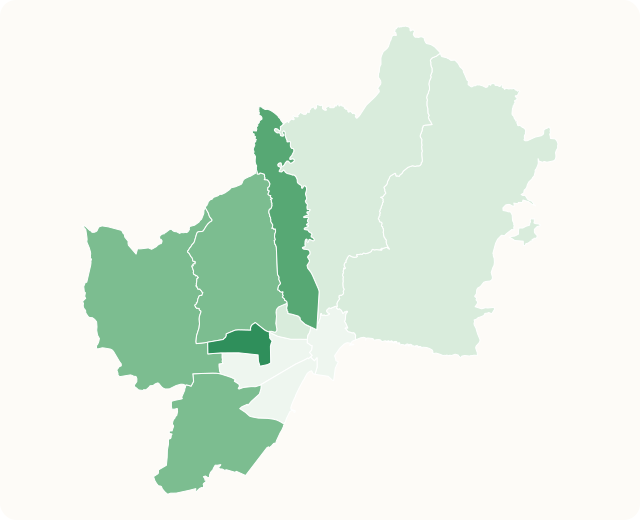 1234567891011
- 1Teatinos-Universidad22.4%
- 2Palma-Palmilla20.2%
- 3Puerto de la Torre19.7%
- 4Campanillas18.9%
- 5Churriana18.8%
- 6Este15.4%
- 7Ciudad Jardín15.4%
- 8Bailén-Miraflores14.7%
- 9Carretera de Cádiz14.4%
- 10Cruz de Humilladero14.0%
- 11Centro13.2%
Share of children under 16 in each of Málaga's 11 districts.

Personal help
Which part of Málaga or the coast fits our family, schools and budget?
Dom finds the areas that match your money and the way you want to live.
Request early accessDom is your AI companion for moving to Spain. Launching soon.

Schools
How school works, and what it costs
Schooling is the decision that shapes everything else, so start it early. Public schools in Andalusia teach in Spanish, and children pick it up fast. Many state schools also run a bilingual programme, where several subjects are taught partly in English, so a child can grow up bilingual inside the free public system. Andalusia has more than a thousand public bilingual schools.
There are three kinds of school. Public schools are free. Concertado schools are state-funded and free in principle, but most ask for a small monthly contribution. In Andalusia that voluntary fee is low, on average around €453 a year, roughly €40 a month. Treat it as a guide, not a fixed price. Private and international schools charge full fees.
This is a Málaga strength. The city and the wider Costa del Sol have about 43 international schools, one of the largest clusters in Spain, with British, American and International Baccalaureate options. Many sit just outside the city along the coast. Treat the search as a project you begin before you move: shortlist several, apply in parallel, and check each school's curriculum, language of instruction and waiting list.
On fees, plan with a range rather than a single figure, and treat every number here as an estimate. International school tuition around Málaga runs from roughly €4,700 at the cheaper end to €28,000 a year at the most exclusive, with most solid options in the €5,000 to €18,000 range. On top of tuition, expect a one-off registration fee, plus recurring costs for lunch, school transport and uniforms. Always confirm the exact figures with each school before you commit.
Childcare
For the small ones
For under-threes, Andalusia runs public nurseries and helps with the cost. The oldest group, age 2 to 3, is free for the care itself, with only meals charged. Younger groups pay on a sliding scale set by your family income, so lower earners pay much less, and larger families and vulnerable households pay less again. Places are allocated each spring, so apply in the window. A private nursery is the faster route if you miss a public place.
Getting around
You do not need a car in the city
Free under 15
Children under 15 travel free across the metropolitan network. A standard adult city bus pass is about €23.95 a month.
Málaga has about 1,345 transit stops across the city buses, two metro lines and the coastal train, and the airport sits just west of the city on that train line. Along the coast the Cercanías C-1 links the beach towns in minutes. In the city most families manage without a car, though one is handy for the inland towns.
Weather through the year
Sunshine almost all year
About 19°C across the year. Mild winters, warm summers cooled by the sea, and most rain in late autumn.
Official figureAEMET normals, Málaga Aeropuerto.
Leisure
The beach, and a city that grew up
Málaga has quietly become one of Spain's best family cities. The beaches run right along the eastern and western edges, calm and shallow, lined with the chiringuito restaurants that grill sardines on the sand. The city has a full set of children's museums and a science centre, the big Parque de Málaga by the port, and a revived old town made for wandering. Behind the coast, the hills and the Montes de Málaga give you real countryside within half an hour.
The one thing to plan for
Rent has caught up with the coast
Málaga's popularity, with tourists, remote workers and international families, has pushed rents well above the rest of Andalusia. A three-bedroom flat is about €1,436 a month outside the centre and around €2,085 in it, and the best listings go quickly. Line up your paperwork, run your school and flat searches at once, and be ready to move fast. Looking a little inland or one town along the coast often buys more space for the money.
If not here
Where families go for more space
Rincón de la Victoria
A relaxed beach town just east of the city, popular with families for its calm seafront and easy road link into Málaga.
Benalmádena and Torremolinos
Coastal towns west of the city on the Cercanías C-1 train, with international schools nearby and a quick ride to the airport.
Alhaurín de la Torre
A greener inland town a short drive from the city, popular with families for its houses and space, though you will want a car.

Personal help
Which part of Málaga or the coast fits our family, schools and budget?
Dom finds the areas that match your money and the way you want to live.
Request early accessDom is your AI companion for moving to Spain. Launching soon.
Sources & provenance
- INE — Padrón, población por nacionalidad y país de nacimientoTier 4 · ES-AN · Retrieved Aug 8, 2026
- Domior Geographic IntelligenceTier 3 · ES-AN · Retrieved Aug 8, 2026
- Zyla — Spain Cost of Living APITier 4 · ES-AN · Retrieved Aug 8, 2026
- Junta de Andalucía — primer ciclo infantil prices and bonificacionesTier 4 · ES-AN · Retrieved Aug 8, 2026
- International Schools Database — Málaga / Costa del SolTier 4 · ES-AN · Retrieved Aug 8, 2026
- International Schools Database — Málaga feesTier 4 · ES-AN · Retrieved Aug 8, 2026
- EMT Málaga — city bus faresTier 4 · ES-AN · Retrieved Aug 8, 2026
- Junta de Andalucía — centros bilingües (Spanish-English public programme)Tier 4 · ES-AN · Retrieved Aug 8, 2026
- EsadeEcPol — concertado fees (Andalusia ~€453/year)Tier 4 · ES-AN · Retrieved Aug 8, 2026
- Consorcio de Transporte Metropolitano del Área de Málaga — free travel for under-15sTier 4 · ES-AN · Retrieved Aug 8, 2026
- AEMET — Valores climatológicos normales, Málaga Aeropuerto (6155A)Tier 4 · ES-AN · Retrieved Aug 8, 2026