
Family life in Seville
Is Seville a good place to raise a family?
Yes, with one big thing to plan for: the summer heat. Seville is a grand, warm and affordable Andalusian capital where children grow up outdoors, in wide plazas and along the river, at rents well below the big coastal cities. A three-bedroom flat is about €947 a month outside the centre. The catch is that Seville is one of the hottest cities in Europe. In July and August the average afternoon reaches about 36°C, so life shifts to the early morning and the evening, homes need air conditioning, and the long school summer holiday makes sense. Plan your year around the heat, and the rest of the time Seville gives a child a gentle, sociable, open-air childhood.
Updated August 2026 · our reading of official public data · Domior Discover

At a glance
Seville for families, in six numbers
8%
International community
about one in twelve residents
674,000
City size
average age 44
15%
Under 16
about one child in six
€947
Three-bed flat
to rent outside the centre; €1,338 in the centre
1,171
Transit stops
metro, tram and bus
San Pablo
Airport
east of the city
A family's budget
What a family spends each month
Rent is the big one, and in Seville it is gentle. Summer air conditioning is the one to remember.
A family
two adults and children
≈ €2,442
Per month
- Rent, three-bed outside the centre
- €947
- Food and groceries for a family
- €680
- Transport, two adult passes (children under 14 free)
- €45
- Power, water, internet and mobile
- €210
- Kids, going out and the rest
- €560
Or somewhere else?
Seville, Málaga or Granada?
Across Andalusia, Seville sits in the middle on price. Here is the same three-bedroom flat in the centre of each.
Seville
- A three-bed in the centre
- €1,338
A grand capital, mid-priced, very hot summers.
Málaga
- A three-bed in the centre
- €2,085
The coast and an airport, at a higher price.
Granada
- A three-bed in the centre
- €1,083
Smaller and cheaper, with student prices.
What family life costs
The costs that come with children
Beyond the monthly budget, these are the line items a family carries. School fees vary a lot, so those are marked as estimates.
free
Public nursery, age 2 to 3
younger ages are charged on a sliding scale by income
€3,900 to €11,200
International school, per year (estimate)
only a few schools, and most do not publish fees
€21.20
One adult monthly pass (children under 14 free)
a TUSSAM 30-day pass; a single ride is €1.40
€210
Family utilities: power, water, cooling
per month; higher in summer
€56
Dinner out for two
mid-range restaurant, three courses
€7.60
A cinema ticket
per ticket
€947
A three-bed flat, per month
outside the centre; about €1,338 in it
Where families live
Seville has children all over it
The share of children under 16 in each of Seville's districts.
There are children in every part of Seville. Families often look at Nervión and Los Remedios, comfortable central districts with parks and good schools, or at the newer, greener areas further out like Sevilla Este and Bermejales, which have more space and modern flats for the money. The old centre is beautiful but tight, and it bakes in summer. A great many families choose the Aljarafe, the ring of leafy towns just across the river, which we come to below. As everywhere, the best tip is simple: choose your school first, then the area around it.
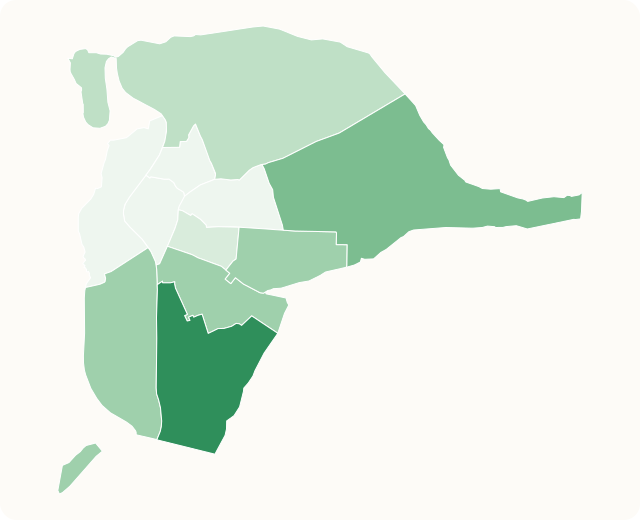 1234567891011
- 1Bellavista - La Palmera19.9%
- 2Este - Alcosa - Torreblanca17.6%
- 3Los Remedios16.3%
- 4Cerro - Amate16.2%
- 5Sur16.1%
- 6Norte15.1%
- 7Nervión14.6%
- 8San Pablo - Santa Justa13.6%
- 9Macarena13.5%
- 10Triana13.1%
- 11Casco Antiguo13.0%
Share of children under 16 in each of Seville's 11 districts.

Personal help
Which part of Seville or the Aljarafe fits our family, schools and budget?
Dom finds the areas that match your money and the way you want to live.
Request early accessDom is your AI companion for moving to Spain. Launching soon.

Schools
How school works, and what it costs
Schooling is the decision that shapes everything else, so start it early. Public schools in Andalusia teach in Spanish, and children pick it up fast. Many state schools also run a bilingual programme, where several subjects are taught partly in English, so a child can grow up bilingual inside the free public system. Andalusia has more than a thousand public bilingual schools.
There are three kinds of school. Public schools are free. Concertado schools are state-funded and free in principle, but most ask for a small monthly contribution. In Andalusia that voluntary fee is low by Spanish standards, on average around €453 a year, roughly €40 a month. Treat it as a guide, not a fixed price. Private and international schools charge full fees.
Seville has only about nine international schools, far fewer than Madrid or the coast, with a mix of British and Montessori options. Because the choice is small, the good places fill up, so start early: shortlist, apply in parallel, and check each school's curriculum, language of instruction and waiting list. Most families here use the strong public and concertado system instead.
On fees, plan with a range rather than a single figure, and treat every number here as an estimate. Among the Seville international schools that publish prices, tuition runs roughly €3,900 to €11,200 a year, though most do not make their fees public, so ask each school directly. On top of tuition, expect a one-off registration fee, plus recurring costs for lunch, school transport and uniforms. Always confirm the exact figures with each school before you commit.
Childcare
For the small ones
For under-threes, Andalusia runs public nurseries and helps with the cost. The oldest group, age 2 to 3, is free for the care itself, with only meals charged. Younger groups pay on a sliding scale set by your family income, so lower earners pay much less, and larger families and vulnerable households pay less again. Places are allocated each spring, so apply in the window. A private nursery is the faster route if you miss a public place.
Getting around
You do not need a car
Free under 14
Children under 14 travel free on the city buses. A TUSSAM 30-day pass is €21.20, and a single ride is €1.40.
Seville has about 1,171 transit stops across its one metro line, the tram and a wide bus network, and the flat, compact centre is one of Spain's great cycling cities, with miles of bike lanes. San Pablo airport sits just east of the city. Between bikes, buses and the metro, most families manage without a car.
Weather through the year
Gentle winters, and a fierce summer
About 20°C across the year. Warm, mild winters, and very hot, dry summers to plan around.
Official figureAEMET normals, Sevilla Aeropuerto.
Leisure
A city made for being outside
For most of the year Seville lives outdoors, and children thrive on it. The María Luisa park, with the Plaza de España and its rowing boats, is the family favourite, and the riverbank along the Guadalquivir is made for bikes and scooters. Cool riverside walks, open plazas for evening play and the great spring feria and Semana Santa give the year a rhythm children love. In the peak of summer, public and hotel pools and short trips to the coast do the rest.
The one thing to plan for
The summer heat
Seville is one of the hottest cities in Europe. In July and August the average afternoon reaches about 36°C, and it can climb higher. Homes need good air conditioning, life moves to the early morning and the evening, and families plan the long school holiday around it, often with time by the coast. It is a real cost and a real rhythm, not a detail. Plan for it and the rest of the year is a gift.
If not here
Where families go for more space
Mairena del Aljarafe
A big, family-popular town on the leafy Aljarafe ridge just west of the city, with a direct Metro line 1 into the centre.
San Juan de Aznalfarache
Right across the river and also on Metro line 1, an easy daily hop into Seville with more room for your money.
Tomares and Bormujos
Prosperous, quiet Aljarafe towns full of houses and good schools, a little cooler than the city, linked in by road and Consorcio bus.

Personal help
Which part of Seville or the Aljarafe fits our family, schools and budget?
Dom finds the areas that match your money and the way you want to live.
Request early accessDom is your AI companion for moving to Spain. Launching soon.
Sources & provenance
- INE — Padrón, población por nacionalidad y país de nacimientoTier 4 · ES-AN · Retrieved Aug 8, 2026
- Domior Geographic IntelligenceTier 3 · ES-AN · Retrieved Aug 8, 2026
- Zyla — Spain Cost of Living APITier 4 · ES-AN · Retrieved Aug 8, 2026
- Junta de Andalucía — primer ciclo infantil prices and bonificacionesTier 4 · ES-AN · Retrieved Aug 8, 2026
- International Schools Database — SevilleTier 4 · ES-AN · Retrieved Aug 8, 2026
- International Schools Database — Seville feesTier 4 · ES-AN · Retrieved Aug 8, 2026
- TUSSAM — Seville fares (children under 14 free; 30-day pass)Tier 4 · ES-AN · Retrieved Aug 8, 2026
- Junta de Andalucía — centros bilingües (Spanish-English public programme)Tier 4 · ES-AN · Retrieved Aug 8, 2026
- EsadeEcPol — concertado fees (Andalusia ~€453/year)Tier 4 · ES-AN · Retrieved Aug 8, 2026
- AEMET — Valores climatológicos normales, Sevilla Aeropuerto (5783)Tier 4 · ES-AN · Retrieved Aug 8, 2026