
Family life in Valencia
Is Valencia a good place to raise a family?
Yes, and it is many families' favourite in Spain. Valencia gives children a big city and a beach at a price that is far kinder than Barcelona or Madrid. Best of all is the Turia, a nine kilometre park that curves right through the middle of the city where the river used to run, full of playgrounds, football pitches and cycle paths. Children bike to school, swim at the beach in summer and grow up outdoors. The one thing to understand early is language: state schools teach in both Valencian and Spanish, though a 2024 law now lets families choose the main language. A three-bedroom flat is about €1,412 a month outside the centre. Sort out the school and the language question early, and Valencia is hard to beat for a young family.
Updated August 2026 · our reading of official public data · Domior Discover

At a glance
Valencia for families, in six numbers
19%
International community
about one in five residents
780,000
City size
average age 45
14%
Under 16
about one child in seven
€1,412
Three-bed flat
to rent outside the centre; €1,974 in the centre
1,374
Transit stops
metro, tram and bus
Manises
Airport
about 8 km west, on the metro
A family's budget
What a family spends each month
Rent is the big one, and in Valencia it is gentler than in the bigger cities.
A family
two adults and children
≈ €2,922
Per month
- Rent, three-bed outside the centre
- €1,412
- Food and groceries for a family
- €680
- Transport, two adult passes (children under 14 free)
- €70
- Power, water, internet and mobile
- €200
- Kids, going out and the rest
- €560
Or somewhere else?
Valencia, Barcelona or Madrid?
Valencia gives you the coast and a big city for clearly less. Here is the same three-bedroom flat in the centre of each.
Valencia
- A three-bed in the centre
- €1,974
A big city and a beach, at a mid-size price.
Barcelona
- A three-bed in the centre
- €2,314
The coast and the buzz, at Spain's highest rents.
Madrid
- A three-bed in the centre
- €2,447
More jobs, but you pay for it, and no sea.
What family life costs
The costs that come with children
Beyond the monthly budget, these are the line items a family carries. School fees vary a lot, so those are marked as estimates.
free
Public nursery, age 2 to 3
younger ages are heavily subsidised by the Bono Infantil
€7,800
International school, per year (estimate)
a typical fee; the range is about €4,400 to €10,600
€35
One adult monthly pass (children under 14 free)
young people under 31 pay about half
€150
Family utilities: power, water, heating
per month
€60
Dinner out for two
mid-range restaurant, three courses
€9
A cinema ticket
per ticket
€1,412
A three-bed flat, per month
outside the centre; about €1,974 in it
Where families live
Valencia has children all over it
The share of children under 16 in each of Valencia's 19 districts.
There are children in every part of Valencia. Families with a bit more room to spend often pick Benimaclet, a village-like area full of students and young families, or the newer buildings of Campanar and around the science park. The beach districts, the Poblats Marítims, put the sand at the end of the street. The old town, Ciutat Vella, is beautiful but tighter and pricier, and some flats there go to holiday lets. Many international families settle just outside the city in the leafy metro towns to the north. As everywhere, the best tip is simple: choose your school first, then the area around it.
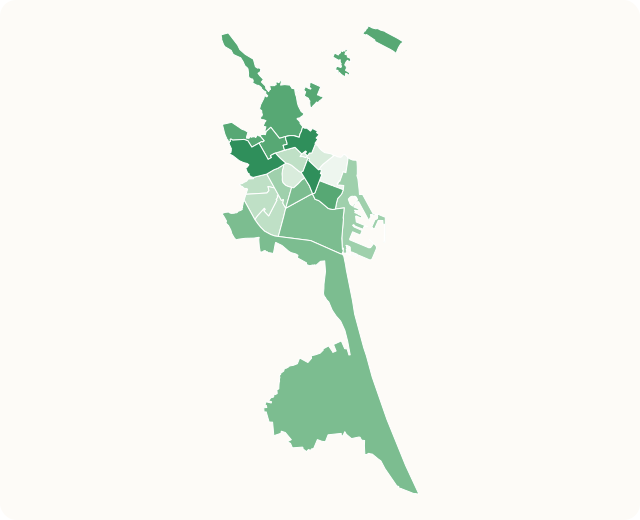 12345678910111213141516171819
- 1Campanar16.2%
- 2Rascanya16.0%
- 3Benicalap15.5%
- 4El Pla del Real15.5%
- 5Poblats del Nord15.2%
- 6Poblats de l'Oest15.2%
- 7Camins al Grau14.9%
- 8Poblats del Sud14.5%
- 9L'Eixample14.3%
- 10Quatre Carreres14.2%
- 11Poblats Marítims13.7%
- 12Extramurs13.3%
- 13Patraix13.1%
- 14Jesús12.9%
- 15La Saïdia12.9%
- 16L'Olivereta12.8%
- 17Ciutat Vella12.3%
- 18Benimaclet12.0%
- 19Algirós11.2%
Share of children under 16 in each of Valencia's 19 districts.

Personal help
Which part of Valencia fits our family, schools and budget?
Dom finds the areas that match your money and the way you want to live.
Request early accessDom is your AI companion for moving to Spain. Launching soon.

Schools
How school works, and what it costs
Schooling is the decision that shapes everything else here, so start it early, and start with the language. State schools in Valencia teach in both Valencian and Spanish. A 2024 regional law now lets families choose which of the two is the main language of the classroom, with the other and English taught alongside. Children pick both up quickly, but deciding the base language, and finding a school that offers it, is the first thing to sort out.
There are three kinds of school. Public schools are free. Concertado schools are state-funded and free in principle, but most ask families for a monthly contribution. Across Spain that voluntary fee averages roughly €680 to €860 a year, about €60 to €70 a month. Treat it as a guide, not a fixed price, because it changes a lot from school to school. Private and international schools charge full fees.
Valencia has about 32 international schools, a good choice for a mid-size city, with British, American and International Baccalaureate options, many of them out in the greener towns around the city. Treat the search as a project you begin before you move. Shortlist several, apply in parallel, and check each school's curriculum, language of instruction and waiting list.
On fees, plan with a range rather than a single figure, and treat every number here as an estimate, not an official price. International school tuition in Valencia runs roughly €4,400 to €10,600 a year, depending on the school, which is noticeably cheaper than Madrid or Barcelona. A typical place sits around €7,800. On top of tuition, expect a one-off registration fee, usually non-refundable, plus recurring costs for lunch, school transport and uniforms. Always confirm the exact figures with each school before you commit.
Childcare
For the small ones
For under-threes, Valencia has become one of the cheapest regions for childcare. The oldest group, age 2 to 3, is free in public and approved private nurseries, and younger ages are heavily subsidised through a grant called the Bono Infantil, which pays a set amount each month towards the fees. Places and grants are allocated in a spring window, so apply on time. A private nursery is the faster route if you miss a public place.
Getting around
You do not need a car
Free under 14
Children under 14 travel free on the metro, tram and bus. Young people under 31 get about half off. A standard adult monthly pass is around €35.
Valencia has about 1,374 transit stops across the metro, tram and bus, and the city is flat, so many families simply cycle. Manises airport sits about 8 km west of the city and is on the metro. Between bikes and the metro, most families get by without a car.
Weather through the year
Warm, sunny, and mild in winter
About 19°C across the year. Gentle winters, warm summers, and most of the rain in autumn.
Official figureAEMET normals, València.
Leisure
The park, the beach and the science city
This is where Valencia shines for families. The Turia gardens run right through the city, nine kilometres of car-free park with the giant Gulliver playground in the middle. At one end sits the City of Arts and Sciences, with its aquarium, the biggest in Europe, and a hands-on science museum. The city beaches, Malvarrosa and Patacona, are a tram ride away, wide and shallow and lined with family restaurants. A weekend rarely needs planning.
The one thing to plan for
The language question
Valencia's schools teach in both Valencian and Spanish. Since 2024 families can choose which is the main language, but that makes it a real decision, not something to leave to chance. Decide early which language you want your child taught in, then look for schools that offer it, because it shapes your shortlist. Sort this out before the spring application window and the rest falls into place.
If not here
Where families go for more space
Godella and Rocafort
Leafy, prosperous towns just north of the city with some of the area's best schools, joined to the centre by Metrovalencia line 1.
L'Eliana
A green, family-first town in the hills to the north-west, full of houses with gardens, on Metrovalencia line 2.
Alboraya
Right next to the city and the beach, known for its market gardens and an easy metro hop in on lines 3 and 9.

Personal help
Which part of Valencia fits our family, schools and budget?
Dom finds the areas that match your money and the way you want to live.
Request early accessDom is your AI companion for moving to Spain. Launching soon.
Sources & provenance
- INE — Padrón, población por nacionalidad y país de nacimientoTier 4 · ES-VC · Retrieved Aug 8, 2026
- Domior Geographic IntelligenceTier 3 · ES-VC · Retrieved Aug 8, 2026
- Zyla — Spain Cost of Living APITier 4 · ES-VC · Retrieved Aug 8, 2026
- Generalitat Valenciana — Bono Infantil / free 2-3 early educationTier 4 · ES-VC · Retrieved Aug 8, 2026
- International Schools Database — ValenciaTier 4 · ES-VC · Retrieved Aug 8, 2026
- International Schools Database — Valencia feesTier 4 · ES-VC · Retrieved Aug 8, 2026
- Metrovalencia — fares (under 14 free; youth 50%)Tier 4 · ES-VC · Retrieved Aug 8, 2026
- DOGV — Llei 1/2024 de llibertat educativa (base language choice)Tier 4 · ES-VC · Retrieved Aug 8, 2026
- EsadeEcPol — Fees at concertado schools in SpainTier 4 · ES · Retrieved Aug 8, 2026
- AEMET — Valores climatológicos normales, València (8416)Tier 4 · ES-VC · Retrieved Aug 8, 2026